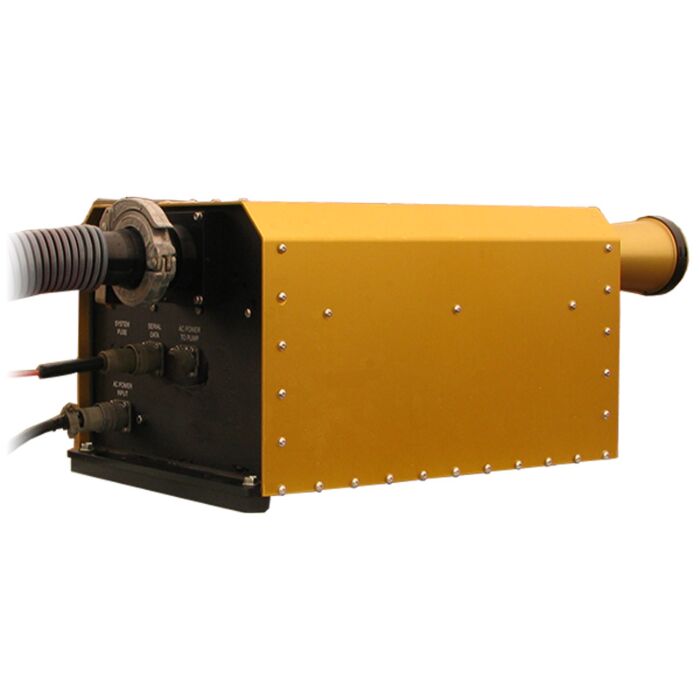
Droplet Measurement Technologies FM-120 for Rent Fog Meter

Droplet Measurement Technologies FM-120 for Rent, Fog Meter

Order # FM-120-RENT2

Mfg # FM-120-RENT2

call-regular 800-828-1470
$0.00
  • Overview
  • Technical Resources
  • Specifications

Droplet Measurement Technologies FM-120 for Rent, Fog Meter

Order # FM-120-RENT2 | Mfg # FM-120-RENT2

Request a Rental Quote

Have a Question? Speak to a Transcat Rental Expert: 800.264.4059

Tariff fees or manufacture imposed surcharges may be applicable.

This product is available for shipping to the United States, Canada, and Puerto Rico only.

Overview

Product Highlights

A popular all-weather optical spectrometer that continuously measures particles in the 2 - 50 µm range.

Advantages

The FM-120 uses state-of-the-art technology to size particles under a wide range of conditions. Its design offers the following state-of-the-art features:

  • Nickel-coated optical flow block to prevent static build-up
  • More robust electronics, with digitized signals from the photodetectors
  • Universal voltage input for analyzer head
  • Particle-by-particle data (optional feature)
  • Dynamic thresholding feature to account for small drifts in baseline signal
  • Raw data available for one particle in each sampling instance, information that serves as an important instrument diagnostic
How it Works

The FM-120 is a forward-scattering optical spectrometer. For accurate sizing, the FM-120 accepts and sizes only particles that pass through a region of the laser beam with uniform power. This region of the laser is called the depth of field. As particles pass through the laser beam, light scatters in all directions. The FM-120 collects forward-scattered photons within an annular cone that is approximately 3.5° to 12° from the laser beam. The collected light is then directed onto a 50/50 optical beam splitter and finally to a pair of photodetectors, referred to as the sizer and the qualifier (see figure). There is a mask in front of the qualifier detector to define the depth of field. The edge of the depth of field is defined by the points where half of the light scattered from a particle is blocked by the mask. The photodetectors then convert the photon pulses into digital pulses. If the qualifier pulse is greater than half the sizer signal, the particle is deemed within the depth of field. The particle is then sized based on the amplitude of the sizer pulse.


Technical Resources

Specifications

Parameter Specification
Measured Parameters Single-particle forward light scattering
Auxiliary Parameters Temperature
Pressure
Derived Parameters Particle diameter
Particle number concentration
Liquid water content (LWC)
Median volume diameter (MVD)
Particle Size Range Droplets with 2-50 µm diameter 
Number of Size Bins 30
Typical Sample Area 0.24 mm² 
Sample Flow Volume 1 m3/min
Sampling Frequency Standard Data Rate: Selectable, 0.04 sec to 20 sec
PBP Data Rate: No limit until particles are coincident
Refractive Index Non-absorbing, 1.33 (the industry standard for water)
Light Collection Angles ~3.5° - 12°
Data System Interface RS-232 or RS-422 serial interface
Up to 460 kB 
Calibration Verification Precision glass beads
Software Particle Analysis and Display System (PADS) software, included
Environmental Operating Conditions Temperature: 0 to 40 °C
Relative Humidity: 0 - 100%, non-condensing
Altitude: 0 - 4,000 meters
Weight 10.0 kg (instrument), 9.5 kg (pump)
Probe Dimensions 23 cm H x 28 cm W x 37 cm L
Power Requirements Universal input for analyzer head, 50-60 Hz
115-120V or 230V for pump (set at factory, but user-configurable)
200W (instrument), 400W (pump)